
Calibration
In order to maximize model accuracy, WatPro can be calibrated for each water treatment facility. An example for Total Trihalomethane (TTHM) calibration is presented as applied to the Britannia Water Treatment Plant (Ottawa, Ontario). The Britannia facility uses chlorine as the primary disinfectant and, typically, treated flow rates range from 155,000 m3/d to 260,000 m3/d.
Study Objectives
- To calibrate a TTHM formulation model for the Britannia Water Treatment Plant using site-specific parameters.
- To demonstrate the improved predictive capability of the calibrated model for TTHM formation realtive to the uncalibrated model.
- To evaluate the number of data points needed to calibrate the model.
Calibration Procedures
- Water samples for TTHM were available at:
- pre-mixing chamber
- post-settling basin
- post-filtration
- final treated water
- Calibrate default WatPro model by multi-parameter least squares regression
- Compare measured with predicted TTHM levels
Uncalibrated Model for TTHM Formation
The form of the TTHM model used in WatPro is based on research conducted by Amy et. al. (Amy G., Chadik and Chowdhury, “Developing Models for Predicting Trihalomethane Formation Potenial and Kinetics”, Journal AWWA, 79:7:89-97 (July, 1987)). The empirical model developed by Amy et. al. is presented below.
TTHM = 0.00309*[(TOC*UV)^0.44]*[Cl2^0.409]*[t^0.265]
*[T^1.06]*[(pH-2.6]^0.715]*[(Br+1)^0.03]
where:
- TTHM = total trihalomethane concentration (umol/L)
- TOC = total organic carbon (mg/L)
- TTHM = total trihalomethane concentration (umol/L)
- TOC = total organic carbon (mg/L)
- UV = UV absorbance at 254 nm (1/cm)
- Cl2 = chlorine dosage (mg/L)
- t = reaction time (h)
- T = temperature (deg C)
- Br = bromide concentration (mg/L)
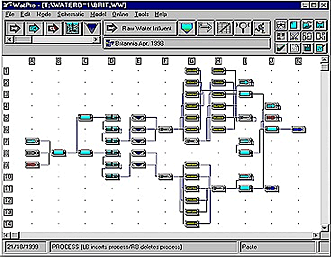
WatPro Schematic of the Britannia Water Treatment Facility
The schematic used to represent the Britannia facility is presented below.
Modeling Results
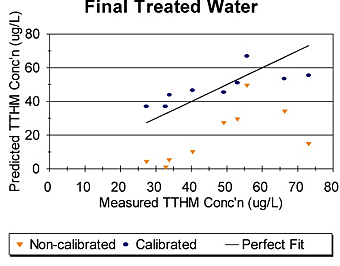
The predictive capability of the calibrated TTHM model is greatly enhanced relative to the uncalibrated model. This is illustrated in the figure below.
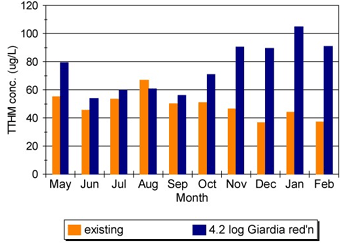
The model predicts that higher levels of TTHMs typically will form if the existing dosage of chlorine is increased to meed the target 4.2 log reduction of Giardia. This is illustrated in the figure below.
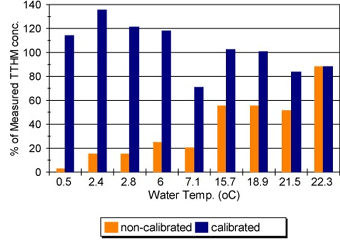
As water temperatures decline, the site specific calibrated model is able to maintain predictive accuracy while the uncalibrated model loses its predictive accuracy for TTHMs. This is illustrated in the figure below.
Modeling Summary/Implications
- THM predictive models must be calibrated to site-specific conditions for accuracy
- uncalibrated models can lead to significant under-estimation of TTHM
- TTHM data collected over a one-year term are typically required for site-specific calibration.